
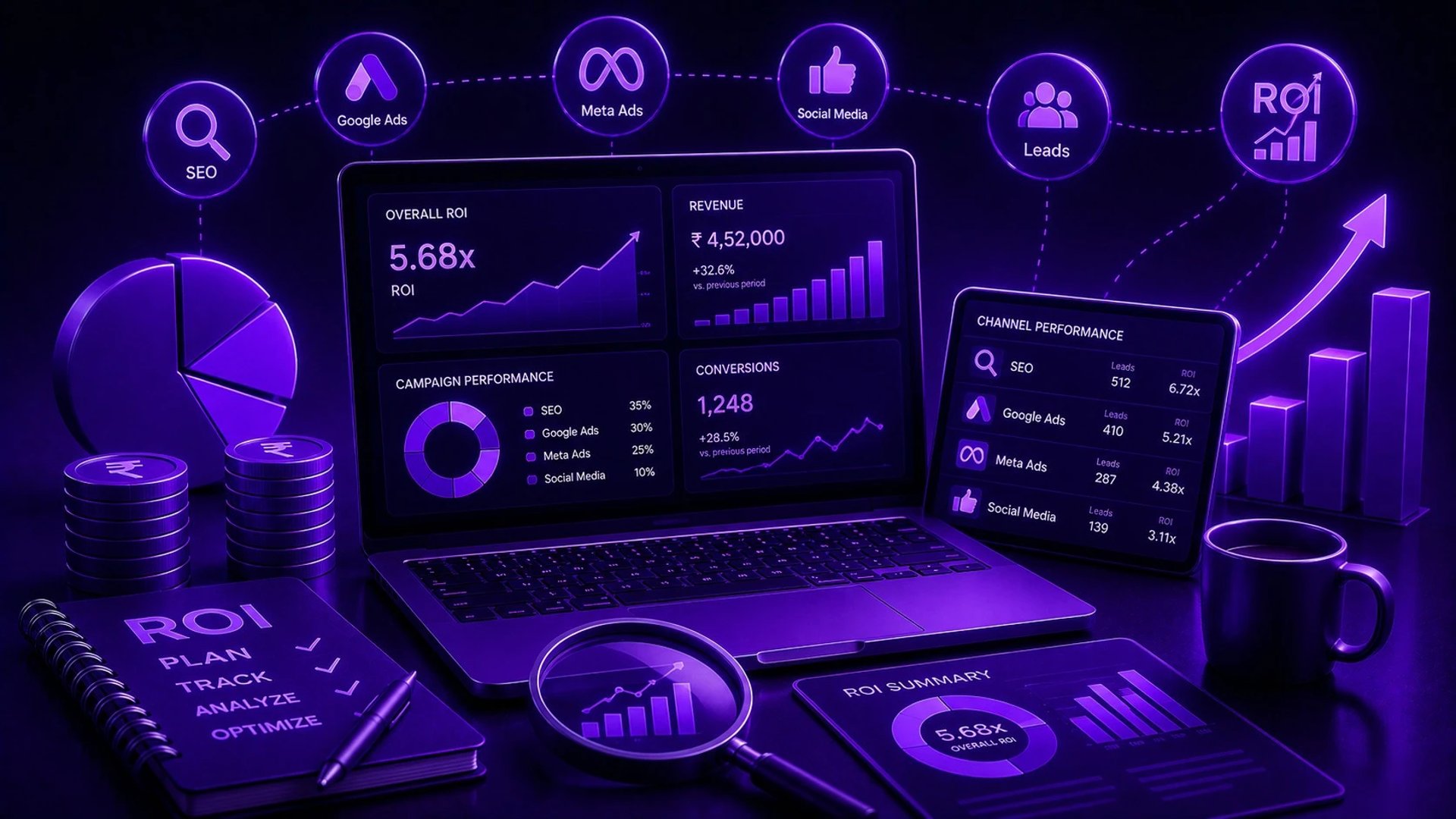
How to Measure Digital Marketing ROI: The Complete Guide
Learn how to measure Digital Marketing ROI using analytics, conversion tracking, lead generation metrics & campaign performance strategies. Discover ROI tracking techniques for SEO, Google Ads, Meta Ads & social media marketing with Hirloye.
DIGITAL MARKETING
5/22/20265 min read
Introduction
Many businesses invest in digital marketing but struggle to answer one important question:
“Is our marketing actually generating results?”
Without proper ROI tracking, businesses often:
Waste advertising budget
Scale the wrong campaigns
Ignore profitable channels
Make poor marketing decisions
This is why understanding Digital Marketing ROI is essential for modern business growth.
ROI stands for Return on Investment.
It measures whether your marketing efforts are generating profitable business outcomes.
Successful businesses do not rely only on:
Likes
Followers
Views
They track:
Leads
Sales
Conversion rates
Revenue
Customer acquisition cost
Profitability
At Hirloye | Empowering Businesses, Elevating Revenues, we help businesses across Chennai, Tamil Nadu, and India track and optimize Digital Marketing ROI using advanced analytics, conversion tracking, and performance-focused marketing systems.
In this complete ROI Guide, we cover:
What Digital Marketing ROI is
Why ROI matters
How to Measure Marketing ROI
Important digital marketing metrics
ROI tracking for SEO
ROI tracking for Google Ads
ROI tracking for Meta Ads
Lead tracking systems
Common ROI mistakes
How Hirloye helps businesses improve marketing profitability
Let’s begin.
What Is Digital Marketing ROI?
Digital Marketing ROI measures how much revenue or business growth your marketing campaigns generate compared to the money invested.
Simple example:
If you spend:
₹10,000 on marketing
and generate:
₹50,000 in sales
your marketing produced positive ROI.
ROI helps businesses understand:
Which campaigns are profitable
Which strategies need improvement
Where budgets should be allocated
ROI tracking transforms marketing from guessing into data-driven growth.
Why Digital Marketing ROI Matters
Many businesses focus only on visibility metrics like:
Likes
Followers
Reach
Views
While these metrics matter, they do not always indicate business growth.
Strong ROI in Digital Marketing focuses on actual business results such as:
Leads
Sales
Revenue
Customer acquisition
Conversion rates
ROI helps businesses scale profitable marketing systems while reducing waste.
The Basic Digital Marketing ROI Formula
The basic ROI formula is:
(Return – Investment) ÷ Investment × 100
Example:
Marketing Spend:
₹20,000
Revenue Generated:
₹80,000
Profit:
₹60,000
ROI:
300%
Positive ROI means campaigns are profitable.
Negative ROI means optimization is needed.
Why Tracking Is Essential in Digital Marketing
One of the biggest advantages of digital marketing is measurability.
Unlike traditional advertising, digital marketing allows businesses to track:
Clicks
Leads
Sales
Website visits
Conversions
User behaviour
This makes Marketing Performance Tracking extremely powerful.
Businesses can continuously optimize campaigns based on data.
Important Digital Marketing Metrics Businesses Should Track
Successful businesses monitor key performance indicators regularly.
Important Digital Marketing Metrics include:
Website traffic
Conversion rate
Cost per lead
Customer acquisition cost
Return on Ad Spend (ROAS)
Click-through rate (CTR)
Bounce rate
Engagement rate
Tracking the right metrics improves decision-making significantly.
Website Traffic Tracking
Website traffic helps businesses understand how many users visit their website.
Traffic sources may include:
Google Search
SEO
Google Ads
Instagram
Facebook
Direct visits
Traffic alone is not enough — quality matters more than quantity.
Conversion Rate Explained
Conversion rate measures how many users take action.
Examples:
Filling forms
Calling businesses
Purchasing products
Booking consultations
Higher conversion rates improve Digital Marketing ROI significantly.
Cost Per Lead (CPL)
CPL measures how much businesses spend to generate one lead.
Example:
₹5,000 ad spend generating 50 leads
CPL = ₹100 per lead
Lower CPL often indicates more efficient campaigns.
Customer Acquisition Cost (CAC)
CAC measures the cost of acquiring one paying customer.
This is one of the most important Business Growth Analytics metrics.
Businesses should compare CAC with customer lifetime value to determine profitability.
Return on Ad Spend (ROAS)
ROAS measures advertising revenue compared to ad spend.
Example:
₹10,000 spent on ads generating ₹50,000 revenue
ROAS = 5x
High ROAS indicates profitable campaigns.
Why Lead Quality Matters More Than Lead Quantity
Many businesses chase large numbers of leads.
But lead quality matters more.
100 low-quality leads may perform worse than 10 highly targeted leads.
Good ROI Tracking Strategy focuses on:
Qualified leads
Buyer intent
Conversion probability
Not just volume.
Google Analytics: The Foundation of ROI Tracking
Google Analytics helps businesses track:
Website visitors
User behaviour
Traffic sources
Conversion data
Analytics reveal:
Which campaigns perform best
Which pages convert
Where users drop off
Data-driven decisions improve marketing profitability.
Conversion Tracking Is Essential
Without conversion tracking, businesses cannot measure actual results.
Businesses should track:
Form submissions
Phone calls
Purchases
WhatsApp inquiries
Appointment bookings
Conversion tracking is critical for Measure Marketing ROI systems.
ROI Tracking for SEO
SEO generates long-term organic traffic.
SEO ROI should measure:
Organic traffic growth
Keyword rankings
Lead generation
Conversion improvements
Revenue from organic visitors
SEO ROI often grows over time because rankings continue generating traffic.
Why SEO Has Long-Term ROI
Unlike ads, SEO traffic continues even after content is published.
Good SEO content can generate:
Leads
Traffic
Visibility
for months or years.
This makes SEO one of the strongest long-term ROI strategies.
ROI Tracking for Google Ads
Google Ads provide measurable data quickly.
Businesses should track:
CTR
CPC
Conversion rates
Cost per lead
ROAS
Google Ads campaigns can be optimized continuously based on performance data.
ROI Tracking for Meta Ads
Meta Ads ROI should measure:
Reach
Engagement
Leads
Website conversions
Cost per result
Meta Ads are especially effective for:
Brand awareness
Lead generation
Retargeting
Performance optimization improves ROI significantly.
Why Landing Pages Affect ROI
Good ads alone are not enough.
Landing pages directly affect:
Conversion rates
Cost per lead
Advertising profitability
Strong landing pages improve:
User experience
Trust
Lead generation
Landing Page Optimization is essential for strong ROI.
Why Retargeting Improves ROI
Most users do not convert immediately.
Retargeting campaigns reconnect with users who already:
Visited websites
Watched videos
Engaged with ads
Retargeting usually improves:
Conversion rates
Brand recall
Advertising efficiency
Retargeting is one of the highest-ROI digital marketing strategies.
Why Attribution Matters
Customers often interact with businesses multiple times before converting.
Example:
First sees Instagram Reel
Later clicks Google Ad
Finally converts through website
Attribution helps businesses understand which channels contribute to conversions.
Good attribution improves marketing budget allocation.
Why Content Marketing ROI Takes Time
Content Marketing and SEO usually require long-term consistency.
Businesses should not expect instant ROI from:
Blogs
SEO
Organic social media
However, long-term content marketing often delivers excellent sustainable growth.
Why Branding Affects Marketing ROI
Strong branding improves:
Trust
Click-through rates
Conversion rates
Customer loyalty
Businesses with weak branding often struggle with lower advertising performance.
Professional branding improves overall marketing efficiency.
Why Mobile Optimization Matters for ROI
Most digital traffic comes from smartphones.
Poor mobile experience reduces:
Conversions
Engagement
Advertising ROI
Mobile optimization improves user experience and profitability significantly.
Common Digital Marketing ROI Mistakes
Many businesses struggle because of avoidable tracking issues.
Common mistakes include:
No conversion tracking
Focusing only on vanity metrics
Poor landing pages
Weak analytics setup
Ignoring lead quality
No retargeting
Inconsistent optimization
Data-driven systems solve these problems.
ROI Tracking for Different Industries
ROI Tracking for Restaurants
Restaurants track:
Reservations
Calls
Walk-ins
Offer redemptions
Local marketing strongly affects restaurant ROI.
ROI Tracking for Real Estate
Real estate businesses measure:
Property inquiries
Site visits
Qualified leads
Cost per lead
Lead quality matters heavily in property marketing.
ROI Tracking for eCommerce
eCommerce businesses track:
ROAS
Cart conversions
Revenue
Customer lifetime value
Sales-focused tracking is essential.
ROI Tracking for Digital Marketing Agencies
Agencies measure:
Lead generation
Consultation bookings
Client acquisition
ROI growth
Performance transparency improves trust.
Why Continuous Optimization Improves ROI
Digital marketing is not a one-time setup.
Successful campaigns require continuous optimization.
Optimization includes:
Creative testing
Audience refinement
Landing page improvements
Ad copy optimization
SEO improvements
Continuous improvement increases profitability over time.
How Hirloye Helps Businesses Measure & Improve ROI
At Hirloye | Empowering Businesses, Elevating Revenues, we help businesses track, analyze, and optimize Digital Marketing ROI through strategic analytics and performance-focused marketing systems.
Our services include:
ROI tracking setup
Google Analytics integration
Conversion tracking
Google Ads optimization
Meta Ads optimization
SEO performance analysis
Lead tracking systems
Marketing analytics reporting
We focus on measurable business growth.
Our ROI Optimization Process
Step 1: Marketing Audit
We analyse:
Existing campaigns
Analytics setup
Traffic sources
Conversion performance
Step 2: Tracking System Setup
We configure:
Google Analytics
Conversion tracking
Event tracking
Lead attribution
Step 3: Campaign Optimization
We improve:
Ad targeting
Landing pages
Content performance
User experience
Step 4: Performance Reporting
We track:
Leads
Sales
ROAS
Conversion rates
ROI performance
Step 5: Scaling Profitable Campaigns
We help businesses scale high-performing campaigns strategically.
This improves long-term profitability.
FAQs: Digital Marketing ROI
Q: What is Digital Marketing ROI?
Digital Marketing ROI measures how much business growth or revenue marketing campaigns generate compared to investment.
Q: Why is ROI important in digital marketing?
ROI helps businesses understand which marketing strategies are profitable.
Q: How do businesses measure marketing ROI?
Businesses measure ROI using analytics, conversion tracking, leads, sales, and advertising performance metrics.
Q: What is ROAS?
ROAS means Return on Ad Spend and measures advertising profitability.
Q: Why does conversion tracking matter?
Conversion tracking helps businesses measure actual results instead of guessing campaign performance.
Q: Which digital marketing channel gives the best ROI?
The best channel depends on business goals, audience, and strategy. SEO, Google Ads, Meta Ads, and content marketing all perform strongly when optimized correctly.
Ready to Improve Your Digital Marketing ROI?
Marketing should not be based on assumptions.
It should be driven by data, conversions, and measurable business growth.
Businesses investing in ROI-focused marketing achieve:
Better profitability
Smarter budget allocation
Higher-quality leads
Stronger campaign performance
Sustainable business growth
At Hirloye | Empowering Businesses, Elevating Revenues, we help businesses across Chennai, Tamil Nadu, and India track and optimize Digital Marketing ROI through analytics, conversion tracking, SEO, Google Ads, Meta Ads, and performance-focused growth strategies.
From Business Growth Analytics and conversion tracking to campaign optimization and ROI reporting — Hirloye handles every aspect of measurable digital marketing growth.
Contact Hirloye today for a FREE Digital Marketing ROI Audit and let’s build marketing systems that generate real business results.
Hirloye — Empowering Businesses, Elevating Revenues. The Best Digital Marketing Company in Chennai — Serving Businesses Across Tamil Nadu & India
Get in Touch
Every great brand transformation starts with a conversation. If you are ready to elevate your visual identity, captivate your audience, and scale with purpose, we’d love to hear your vision. Reach out to our team today, and let’s explore how we can architect your next big move
Pages
info@hirloye.com
+91 79047 13677
© 2025. All rights reserved.
Quick Links





online support
Mon to Sat : 10 AM to 6 PM
For Business Enquiry


NMK Street,Ayanavaram, Chennai - 600023