
SEO: The Ultimate Guide to Search Engine Optimization That Grows Your Business & Revenue
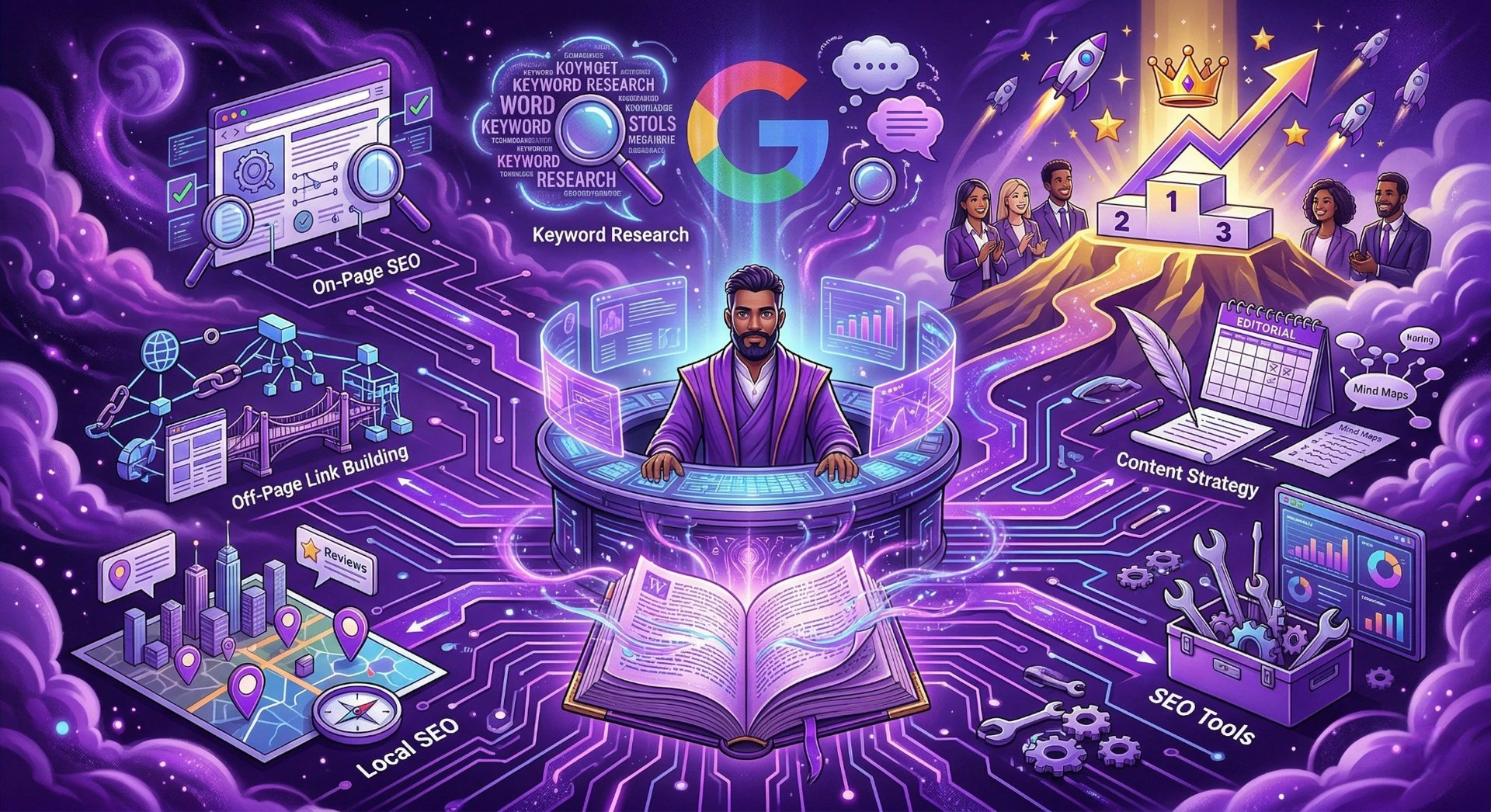
Master SEO with Hirloye's ultimate guide. Learn On-Page SEO, Off-Page Link Building, Local SEO, Keyword Research, Content Strategy & SEO Tools that grow your business on Google.
SEO & ORGANIC GROWTH
3/26/202621 min read
INTRODUCTION :
Imagine waking up every morning to find new leads, new enquiries, and new customers waiting in your inbox — without spending a single rupee on paid advertising.
That's not a fantasy. That's the power of Search Engine Optimization (SEO) done right.
SEO is the single most powerful long-term digital marketing strategy available to any business today. While Google Ads and Meta Ads deliver results only as long as you keep paying for them, SEO builds a compounding organic search presence that generates free, high-intent website traffic from Google Search — month after month, year after year — long after the initial investment.
In a world where 8.5 billion searches happen on Google every single day, ranking at the top of Google's search results for the keywords your customers are typing puts your business directly in front of the most motivated buyers on the internet — people who are actively searching for exactly what you offer, right at the moment they're ready to take action.
But here's the truth most businesses don't hear: SEO is not magic, and it's not a shortcut. It is a strategic, multi-layered discipline that requires deep keyword research, expert on-page optimisation, authoritative content creation, powerful backlink building, and technical precision — all working together consistently over time.
At Hirloye | Empowering Businesses, Elevating Revenues, SEO is one of our most powerful service offerings. We have helped businesses across industries climb Google's search rankings, generate organic leads, and build sustainable revenue streams through data-driven, results-focused search engine optimisation strategies.
In this comprehensive SEO guide, we cover everything:
What SEO is and how Google Search works
How SEO directly grows your business revenue
On-Page SEO — optimising every element of your website
Off-Page SEO & Link Building — building authority that Google trusts
Local SEO & Google My Business — dominating your local market
Keyword Research — finding the exact terms your customers search
Content Writing for SEO — creating content that ranks and converts
Backlink Building Strategy — the most powerful off-page SEO technique
SEO Tools — Ahrefs, SEMrush, Google Search Console & more
Hirloye's proven 6-step SEO process
Let's dive in.
What Is SEO? (Search Engine Optimization Explained)
Search Engine Optimization (SEO) is the practice of optimising your website, content, and online presence to rank higher in organic (unpaid) search engine results — primarily on Google Search, which commands over 92% of the global search engine market share.
When someone types a search query into Google — whether it's "digital marketing agency in Chennai", "best running shoes under 3000", or "how to file GST returns" — Google's search algorithm crawls, indexes, and ranks millions of web pages to determine which results are most relevant, most authoritative, and most useful for that specific search query.
SEO is the process of making your website and content tick every box that Google's algorithm looks for — so your pages consistently appear at the top of Search Engine Results Pages (SERPs) for the keywords that matter most to your business.
Unlike paid search advertising (Google Ads / PPC), organic SEO traffic is:
Free — you don't pay per click
Compounding — rankings and traffic grow over time
Highly credible — users trust organic results more than paid ads
Sustainable — rankings persist even when you reduce your marketing budget
High-intent — users searching specific keywords are actively looking for solutions
How Google Search Works
Understanding how Google works is fundamental to understanding SEO. Google uses three core processes to serve search results:
Crawling Googlebot — Google's automated web crawler — constantly browses the internet, following links from page to page and discovering new and updated web content. If your website isn't crawlable, Google can't index it.
Indexing After crawling, Google analyses and stores page content in its massive search index — a database of hundreds of billions of web pages. Only indexed pages can appear in Google Search results.
Ranking When a user performs a Google search, Google's ranking algorithm evaluates all indexed pages relevant to that search query and ranks them based on hundreds of ranking factors — including content relevance, page authority, backlink profile, user experience signals, page speed, mobile-friendliness, and many more.
SEO is the art and science of optimising your website for all of these factors — so Google consistently chooses YOUR pages to show at the top.
Why SEO Is the Most Powerful Revenue-Generating Strategy for Your Business
SEO Delivers the Highest Long-Term ROI of Any Digital Marketing Channel
Unlike paid advertising which stops generating traffic the moment you stop paying, SEO builds equity. Every blog post you publish, every backlink you earn, every on-page optimisation you implement compounds over time — creating an ever-growing organic traffic engine that delivers free website visitors month after month.
The ROI of SEO is unmatched in digital marketing:
SEO leads have a 14.6% close rate compared to 1.7% for outbound marketing
Organic search drives 53% of all website traffic across the internet
#1 position on Google captures 27.6% of all clicks for that search query
Top 3 Google results receive over 75% of all clicks on the first page
Businesses investing in SEO see an average ROI of 748% over three years
Content marketing + SEO costs 62% less than traditional marketing while generating 3x more leads
SEO Captures Buyers at the Moment of Highest Intent
Organic search traffic from Google is the highest-quality website traffic available — because every visitor arrived by actively searching for something specific. They have a problem they want solved, a product they want to buy, or a service they want to hire. This level of purchase intent is simply unmatched by any other digital marketing channel.
SEO Builds Unbeatable Brand Authority & Credibility
Consistently ranking at the top of Google Search results for competitive keywords in your industry positions your brand as the definitive authority in your space. Organic search rankings are a powerful trust signal — consumers inherently trust businesses that rank at the top of Google more than those they've never encountered organically.
SEO Creates Compounding, Sustainable Growth
A well-executed SEO strategy creates compounding growth. A blog post published today can continue generating organic traffic and leads for years. A backlink earned today strengthens your domain authority permanently. An on-page SEO optimisation made today improves every future Google crawl. Unlike paid advertising, SEO investments never expire.
On-Page SEO: Optimising Every Element of Your Website
On-Page SEO refers to all the optimisation techniques applied directly to your website pages to improve their Google search rankings and organic visibility. It is the foundation of every successful SEO strategy — and it begins with making sure every page on your website communicates its topic, purpose, and value to Google's algorithm as clearly as possible.
Keyword Research & Keyword Targeting
Keyword research is the cornerstone of all on-page SEO. Before optimising any page, you must understand exactly what search terms your target audience is using on Google — their specific language, phrasing, questions, and search intent.
Types of Keywords in SEO:
Short-Tail Keywords (Head Keywords) Broad, high-volume, highly competitive keywords with 1–2 words. Examples: "SEO", "digital marketing", "website development". These drive massive search volume but are extremely competitive and have broad search intent.
Long-Tail Keywords Specific, lower-volume, lower-competition keyword phrases with 3+ words. Examples: "SEO services for small business in Chennai", "how to improve Google ranking for my website", "best digital marketing agency for eCommerce India". Long-tail keywords consistently convert better than short-tail keywords because they have highly specific search intent.
LSI Keywords (Latent Semantic Indexing) LSI keywords are semantically related terms and phrases that Google's algorithm uses to understand the full context and topic of a web page. Including LSI keywords throughout your content signals topical depth and comprehensiveness to Google.
Search Intent Keywords Every keyword has a specific search intent — what the user is trying to accomplish:
Informational intent — "what is SEO", "how does Google ranking work"
Navigational intent — "Hirloye digital marketing agency"
Commercial intent — "best SEO agency India", "SEO services price"
Transactional intent — "hire SEO expert", "buy SEO services online"
Matching your content to the correct search intent is one of the most critical factors in on-page SEO success.
Keyword Research Tools We Use:
Google Keyword Planner — free keyword research tool inside Google Ads Manager
Google Search Console (GSC) — shows which keywords already drive traffic to your site
Google Trends — identifies seasonal keyword trends and rising search queries
Ahrefs Keywords Explorer — industry-leading keyword research with search volume, keyword difficulty, click-through data, and SERP analysis
SEMrush Keyword Magic Tool — comprehensive keyword database with competitive keyword analysis and keyword gap identification
Ubersuggest — accessible keyword research tool for businesses new to SEO
AnswerThePublic — visualises the questions and search queries people ask around any topic
Title Tags & Meta Descriptions
Title tags and meta descriptions are the first thing users see when your page appears in Google Search results — and they are among the most important on-page SEO elements.
Title Tag Best Practices:
Include your primary keyword as close to the beginning as possible
Keep title tags between 50–60 characters to avoid truncation in SERPs
Make every title tag unique across your entire website
Include your brand name at the end: "SEO Services India | Hirloye"
Write for humans first — compelling title tags improve click-through rates (CTR)
Meta Description Best Practices:
Include your primary keyword and secondary keywords naturally
Keep meta descriptions between 140–160 characters
Write a compelling value proposition that encourages users to click
Include a call to action — "Learn more", "Get a free SEO audit", "Discover how"
Make every meta description unique — duplicate meta descriptions hurt SEO
Heading Structure (H1, H2, H3)
Proper heading structure helps Google's algorithm understand the hierarchy and organisation of your content — and helps users scan and navigate your pages easily.
H1 — One per page, contains your primary keyword, clearly states the topic of the page
H2 — Main section headings, include secondary keywords and LSI keywords
H3 — Sub-section headings, support H2 topics with more specific keyword variations
URL Structure & Internal Linking
Clean, keyword-rich URL structures are a fundamental on-page SEO signal:
Use lowercase letters and hyphens (not underscores) between words
Include your primary keyword in the URL slug: /seo-services-india/ not /page?id=123
Keep URLs short and descriptive — avoid unnecessary parameters and numbers
Internal linking — linking from one page on your website to another — is a powerful on-page SEO technique that:
Distributes link equity (PageRank) across your website
Helps Google crawl and index all your pages
Guides users to relevant content, increasing dwell time and reducing bounce rate
Establishes topical authority by creating content clusters around core topics
Image Optimisation
Image SEO is a frequently overlooked on-page optimisation opportunity:
Alt text — descriptive, keyword-rich alternative text for every image
Image file names — descriptive names before uploading (seo-services-india.jpg not IMG001.jpg)
Image compression — reduce file sizes without quality loss for faster page load speed
Next-gen formats — WebP images load faster than JPEG/PNG and improve Core Web Vitals
Image sitemaps — help Google discover and index your images in Google Image Search
Page Speed & Core Web Vitals
Page speed and Google's Core Web Vitals are direct Google ranking factors that also significantly impact user experience and conversion rates:
Largest Contentful Paint (LCP) — how fast your main content loads (target: under 2.5 seconds)
First Input Delay (FID) / Interaction to Next Paint (INP) — how quickly your page responds to user interaction (target: under 200ms)
Cumulative Layout Shift (CLS) — visual stability as the page loads (target: under 0.1)
Page speed optimisation techniques:
Image compression and WebP conversion
Browser caching and server-side caching
Content Delivery Network (CDN) implementation
CSS and JavaScript minification
Lazy loading for below-the-fold images
Premium web hosting with fast server response times
Mobile-First Optimisation
Google uses mobile-first indexing — meaning Google primarily uses the mobile version of your website for crawling, indexing, and ranking. A website that is not fully mobile-optimised will suffer significant Google ranking penalties regardless of how good the desktop version looks.
Mobile SEO essentials:
Responsive web design that adapts to all screen sizes
Touch-friendly navigation — buttons and links large enough for thumbs
Fast mobile page load speed — mobile users are less patient than desktop users
No intrusive interstitials — pop-ups that cover content on mobile are penalised by Google
Readable font sizes without needing to zoom
Schema Markup & Structured Data
Schema markup (structured data) is code added to your website that helps Google understand the specific type of content on each page — enabling rich results in Google Search like star ratings, FAQ accordions, price ranges, event dates, and breadcrumb navigation.
Rich results significantly improve click-through rates (CTR) from Google SERPs — making schema markup one of the highest-value technical SEO investments available.
Common schema types:
Organization schema — business name, logo, contact information
Local Business schema — address, phone, hours, coordinates
Product schema — price, availability, reviews, ratings
Article schema — blog posts and news articles
FAQ schema — expandable Q&A sections in Google Search results
Review schema — star ratings visible in SERPs
Breadcrumb schema — navigation path shown in search result
Content Writing for SEO: Creating Content That Ranks & Converts
Content is the fuel that powers every SEO strategy. Without high-quality, keyword-optimised content, even the most technically perfect website will struggle to rank on Google. SEO content writing is the art of creating content that simultaneously satisfies Google's ranking algorithm and provides genuine value to human readers.
The Relationship Between Content & SEO Rankings
Google's search algorithm — particularly its E-E-A-T framework (Experience, Expertise, Authoritativeness, Trustworthiness) — evaluates content quality as a primary ranking factor. Pages that demonstrate deep expertise, provide comprehensive information, cite credible sources, and genuinely answer user search queries consistently rank higher than thin, superficial content.
Google's Helpful Content System — introduced as a core algorithm update — specifically targets and demotes content written primarily for search engines rather than humans. In 2025, the only SEO content strategy that works long-term is one built around creating genuinely useful, people-first content.
Types of SEO Content That Drive Organic Traffic & Revenue
Blog Posts & Articles SEO blog posts are the backbone of most content marketing strategies. Regularly publishing keyword-targeted blog content on your business website:
Drives organic search traffic for long-tail keywords your homepage can't target
Builds topical authority — signalling to Google that your site is a comprehensive resource on your subject
Generates backlinks — high-quality blog content naturally attracts links from other websites
Nurtures potential customers through the buying journey by answering their questions
Supports internal linking structure across your entire website
Best practices for SEO blog writing:
Keyword research first — every blog post targets a specific primary keyword with supporting LSI keywords
Search intent alignment — match your content format and depth to what Google's top results provide
Comprehensive coverage — cover the topic more thoroughly than competing pages (target 2,000–4,000 words for competitive keywords)
Engaging headlines — use your primary keyword in the H1 while making it compelling to click
Structured content — use H2/H3 headings, bullet points, numbered lists, tables, and images to improve readability
Internal links — link to relevant pages and posts throughout your website
Call to action (CTA) — every SEO blog post should guide readers toward a next step
Service & Landing Pages Your core service pages and product pages must be fully SEO-optimised with primary keywords, LSI keywords, schema markup, clear CTAs, social proof, and fast load speeds — because these are the pages that directly generate leads and revenue from organic search.
FAQ Pages FAQ pages targeting question-based long-tail keywords ("how much does SEO cost in India", "what is the difference between on-page and off-page SEO") capture valuable informational search traffic and frequently earn Featured Snippet positions in Google Search — the coveted Position Zero that appears above all other search results.
Pillar Pages & Topic Clusters Content pillar pages are comprehensive, long-form SEO pages that provide a complete overview of a broad topic — supported by a cluster of related blog posts that cover specific sub-topics in depth. This pillar-cluster content model is one of the most effective SEO content strategies for building topical authority and ranking for highly competitive keywords.
Case Studies & Success Stories SEO case studies and client success stories serve double duty — they provide powerful social proof that converts prospects into clients, AND they naturally contain industry keywords, result-specific terms, and service-related phrases that attract organic search traffic.
SEO Copywriting Best Practices
Keyword density — use your primary keyword naturally throughout the content (aim for 1–2% density — avoid keyword stuffing that reads unnaturally)
Keyword placement — include primary keyword in the title tag, H1, first paragraph, at least one H2, and the conclusion
Semantic keywords — use related terms and synonyms naturally throughout — Google understands context
Readability — write at a reading level your audience can easily engage with (use short sentences, active voice, clear language)
Content freshness — regularly update and republish older SEO content to maintain and improve Google rankings
Word count — longer, more comprehensive content consistently ranks higher for competitive keywords (aim for 1,500–3,000+ words for main service pages and competitive blog posts)
Off-Page SEO & Link Building: Building the Authority Google Trusts
Off-Page SEO refers to all SEO activities that take place outside your own website — primarily focused on building domain authority, brand mentions, and backlinks that signal to Google that your website is a credible, trustworthy, and authoritative source of information.
While on-page SEO tells Google what your website is about, off-page SEO tells Google how much the rest of the internet trusts your website. And in Google's algorithm, trust and authority are everything.
What Is Domain Authority (DA) & Why It Matters
Domain Authority (DA) is a metric developed by Moz (and similar metrics like Domain Rating (DR) by Ahrefs and Authority Score by SEMrush) that predicts how likely a website is to rank in Google Search results based on the quality and quantity of its backlink profile.
Domain Authority is scored from 1 to 100 — the higher the score, the stronger the website's organic search ranking potential. A new website typically starts with a DA of 1 — and builds authority over time through link building, content creation, and brand mentions.
Key factors that influence Domain Authority:
Number of unique referring domains linking to your website
Quality and authority of those linking websites
Relevance of linking websites to your industry
Anchor text diversity and naturalness
Link velocity — the rate at which you acquire new backlinks
Backlink Building Strategy: The #1 Off-Page SEO Technique
Backlinks (also called inbound links or external links) are links from other websites pointing to your website. They are the single most powerful off-page SEO ranking signal — because every backlink is essentially a vote of confidence from one website to another, telling Google that your content is worth referencing.
Not all backlinks are equal. A single backlink from a high-authority, relevant website can be worth more than hundreds of links from low-quality sites. Google's Penguin algorithm actively penalises websites with spammy, manipulative, or low-quality backlink profiles.
Types of Backlinks:
High-Authority Editorial Backlinks Links earned naturally when other websites — news sites, industry blogs, research publications, government websites, educational institutions — reference and link to your content because it provides genuine value. These are the most powerful and most coveted backlinks in SEO.
Guest Post Backlinks Guest blogging — writing and publishing articles on other relevant websites in your industry in exchange for a backlink to your site — is one of the most effective link building strategies available. High-quality guest posts on authoritative, relevant websites build domain authority, referral traffic, and brand visibility simultaneously.
Press Release & PR Backlinks Digital PR campaigns — distributing press releases through PR distribution services and earning coverage in online news publications, industry magazines, and media websites — generate powerful editorial backlinks from high-authority news domains.
Business Directory Backlinks Listing your business in high-quality online business directories — Google Business Profile, Justdial, Sulekha, IndiaMart, Clutch, Yelp, Yellow Pages — builds local SEO authority and generates consistent citation backlinks.
Niche Relevant Backlinks Links from websites in the same or closely related industry as yours carry significantly more SEO value than links from unrelated websites. Building niche-relevant backlinks through industry partnerships, resource page link building, and broken link building is a core component of every Hirloye SEO strategy.
Social Profile Backlinks Social media profiles — LinkedIn, Facebook, Instagram, Twitter/X, YouTube — all provide backlinks to your website and contribute to your overall online authority and brand presence in Google Search.
Resource Page Link Building Many high-authority websites maintain resource pages — curated lists of useful tools, guides, and references for their audience. Identifying relevant resource pages and pitching your best content for inclusion is a highly effective white-hat link building strategy.
Competitor Backlink Analysis One of the most powerful link building strategies is analysing where your competitors are getting their backlinks — and replicating or improving on those same link sources. Tools like Ahrefs, SEMrush, and Moz make competitor backlink analysis fast and actionable.
At Hirloye, we exclusively practice white-hat SEO — building sustainable, Google-compliant SEO strategies that deliver long-term results without risking Google penalties or manual actions against your website.
Brand Mentions & Unlinked Citations
Brand mentions — instances where other websites mention your business name without linking to you — are increasingly recognised by Google as an off-page SEO signal. Converting unlinked brand mentions into actual backlinks (through outreach) is a quick-win link building tactic that improves domain authority without creating new content.
Local SEO & Google My Business: Dominating Your Local Market
Local SEO is the practice of optimising your online presence to attract local customers searching for businesses, products, or services in a specific geographic area. For any business that serves customers in a specific city, region, or local area — local SEO is the most direct path to new customers, phone calls, walk-ins, and local revenue.
When someone in Chennai searches "digital marketing agency near me" or "SEO services in Chennai" — Google's local search algorithm determines which businesses appear in the Local Pack (the map and three business listings that appear at the top of local search results) and in organic local search results.
Google My Business (Google Business Profile) Optimisation
Google My Business (GMB) — now officially called Google Business Profile (GBP) — is the free Google tool that controls how your business appears in Google Search, Google Maps, and Google's Local Pack. A fully optimised Google Business Profile is the single most important factor in local SEO rankings.
Complete Google Business Profile Optimisation Checklist:
Business Name, Address & Phone (NAP) Your business name, address, and phone number must be 100% accurate, consistent, and identical across your GMB listing, your website, and every online business directory where your business is listed. NAP consistency is a fundamental local SEO ranking signal.
Business Category Selection Choosing the most accurate primary business category and relevant secondary categories on Google Business Profile is critical for appearing in the right local search queries. Choose categories that precisely describe your core business — not aspirational categories.
Business Description Write a comprehensive, keyword-rich business description (up to 750 characters) that clearly communicates what your business does, who you serve, and what makes you unique — naturally incorporating your most important local SEO keywords.
Google Business Profile Photos & Videos GMB listings with photos receive 42% more requests for directions and 35% more website click-throughs than those without. Upload high-quality photos of your office, team, products, services, and work samples — and update them regularly.
Google Reviews & Reputation Management Google Reviews are one of the most powerful local SEO ranking factors — and the most powerful trust signal for local consumers. Businesses with more positive Google reviews rank higher in the Local Pack and convert more visitors into customers.
Strategies for generating more Google Reviews:
Ask satisfied customers directly — in person, via WhatsApp, or by email
Include a direct Google Review link in your email signature and post-service follow-ups
Respond to every review — positive and negative — professionally and promptly
Never buy fake reviews — Google's algorithm detects and penalises fake review patterns
Google Posts Google Posts allow you to publish updates, offers, events, and new content directly on your Google Business Profile — appearing in Google Search and Google Maps results for your business. Regular Google Posts signal activity and engagement to Google's local algorithm.
Questions & Answers (Q&A) Proactively populate the Q&A section of your Google Business Profile with common questions and comprehensive answers — naturally incorporating local keywords and service-related terms.
Service Areas & Local Keywords For service area businesses (businesses that serve customers at their location rather than a fixed address), properly configuring service areas on Google Business Profile is essential for appearing in local search results across your entire service territory.
Local Citation Building
Local citations are online mentions of your business name, address, and phone number (NAP) on external websites — business directories, local listings, industry platforms, and review sites. Building consistent, accurate local citations across high-authority directories is a foundational local SEO strategy.
Top local citation sources for Indian businesses:
Google Business Profile (essential)
Justdial
Sulekha
IndiaMart
TradeIndia
Facebook Business Page
LinkedIn Company Page
Yelp India
Yellow Pages India
Clutch (for agencies and service providers)
Trustpilot
Industry-specific directories
Citation consistency is critical — even minor variations in your business name, address, or phone number across different directory listings can confuse Google and negatively impact your local SEO rankings.
Local Keyword Optimisation
Local SEO requires targeting geo-modified keywords — search terms that combine your service with your location:
"SEO agency Chennai"
"digital marketing services India"
"website development company near me"
"Google Ads management Chennai"
"social media marketing agency Tamil Nadu"
These local keywords should appear in your website's title tags, meta descriptions, H1 headings, service page content, GMB description, blog posts, and local landing pages — creating comprehensive local keyword coverage that helps Google understand exactly where you operate and who you serve.
Local Landing Pages
For businesses serving multiple cities or geographic areas, creating dedicated local landing pages — separate pages optimised for each specific location ("/seo-services-chennai/", "/digital-marketing-bangalore/") — dramatically improves local search visibility across all target markets.
SEO Tools: The Technology Behind Data-Driven SEO
At Hirloye, we use the industry's most powerful SEO tools to research, implement, monitor, and continuously optimise our clients' SEO strategies. Here's a complete breakdown of the SEO tools we use and what they do:
Google Search Console (GSC)
Google Search Console is a free Google tool that provides direct insights into how Google views and interacts with your website. It is the most important SEO monitoring tool available — because the data comes directly from Google.
What Google Search Console shows you:
Search performance — which keywords your pages rank for, their average position, impressions, clicks, and CTR
Index coverage — which pages are indexed by Google and which have crawl errors
Core Web Vitals — your page speed and user experience scores
Mobile usability — mobile-specific issues affecting your Google rankings
Backlinks — which websites link to your pages
Manual actions — whether Google has penalised any pages on your site
Sitemaps — submit and monitor your XML sitemap
Google Analytics 4 (GA4)
Google Analytics 4 (GA4) is Google's latest website analytics platform — providing comprehensive data on your website traffic, user behaviour, conversion paths, and marketing performance.
Key GA4 metrics for SEO:
Organic search traffic — users arriving from Google Search
Organic search landing pages — which pages receive the most SEO traffic
Engagement rate — how users interact with your organic traffic pages
Conversions — leads, purchases, and key actions completed by organic search visitors
User journey analysis — how organic visitors navigate through your website
Ahrefs
Ahrefs is one of the most powerful and comprehensive SEO tools in the industry — used by professional SEO agencies worldwide for keyword research, backlink analysis, competitor research, content research, and rank tracking.
Key Ahrefs features:
Site Explorer — complete backlink profile analysis for any website
Keywords Explorer — in-depth keyword research with search volume, keyword difficulty, click data, and SERP analysis
Content Explorer — discover the best-performing content in any niche for link building and content ideas
Rank Tracker — monitor your Google keyword rankings over time
Site Audit — comprehensive technical SEO audit identifying all on-page and technical SEO issues
Competitor Analysis — analyse competitors' organic keywords, backlink profiles, and content strategies
SEMrush
SEMrush is an all-in-one digital marketing platform combining SEO, PPC, content marketing, social media, and competitive intelligence tools — making it one of the most versatile SEO tools available.
Key SEMrush features:
Domain Overview — complete SEO performance snapshot for any domain
Keyword Magic Tool — one of the largest keyword databases in the industry
Backlink Analytics — comprehensive backlink profile analysis and toxic link identification
Position Tracking — daily keyword rank tracking with competitor comparisons
On-Page SEO Checker — actionable on-page SEO recommendations for every page
SEO Content Template — content writing guidelines based on Google's top-ranking pages
Link Building Tool — prospect identification and outreach management for backlink campaigns
Technical SEO Audit — crawl your website for technical SEO issues and prioritised fixes
Moz Pro
Moz Pro is one of the pioneering SEO software platforms — best known for its Domain Authority (DA) and Page Authority (PA) metrics, which have become industry-standard measures of website SEO authority.
Key Moz features:
Link Explorer — backlink analysis and Domain Authority checking
Keyword Explorer — keyword research with search volume and keyword difficulty
MozBar — browser extension for instant SEO metrics on any webpage
Rank Tracker — monitor keyword position changes over time
Site Crawl — identify technical SEO issues across your entire website
Screaming Frog SEO Spider
Screaming Frog is a powerful website crawler that audits your entire website for technical SEO issues in minutes:
Broken links (404 errors)
Duplicate content and duplicate meta tags
Missing title tags and meta descriptions
Redirect chains and redirect loops
Missing image alt text
Pages blocked from crawling
Orphan pages with no internal links
Hirloye's Proven 6-Step SEO Process
At Hirloye | Empowering Businesses, Elevating Revenues, we follow a comprehensive, data-driven 6-step SEO process that delivers consistent, measurable organic growth for every client:
Step 1: SEO Audit & Competitive Analysis
Every SEO engagement begins with a thorough SEO audit of your existing website — using Ahrefs, SEMrush, Google Search Console, and Screaming Frog to identify every technical SEO issue, on-page optimisation gap, content opportunity, and backlink profile weakness. Simultaneously, we conduct in-depth competitor SEO analysis — mapping exactly how your top competitors are ranking and identifying the keyword gaps and link building opportunities you can capitalise on.
Step 2: Keyword Research & SEO Strategy
Armed with audit data and competitor insights, our SEO strategists conduct comprehensive keyword research — building a complete keyword map that assigns specific target keywords to every page on your website and identifies new content opportunities. We then build your complete SEO strategy — a prioritised roadmap covering on-page optimisation, content creation, link building, and local SEO over a defined timeframe.
Step 3: On-Page SEO Optimisation
We implement all on-page SEO optimisations across your website — optimising title tags, meta descriptions, heading structures, URL slugs, image alt text, internal linking, schema markup, page speed, and Core Web Vitals. For new pages, we build fully SEO-optimised page templates from the ground up. This step transforms your website into a technically perfect foundation for organic search rankings.
Step 4: SEO Content Creation
Our SEO content writers create high-quality, keyword-targeted content — blog posts, service pages, landing pages, FAQ pages, and pillar content — that simultaneously ranks on Google and converts readers into customers. Every piece of SEO content is built around a specific target keyword, aligned with user search intent, and structured for maximum readability and engagement.
Step 5: Off-Page SEO & Link Building
Our link building team executes a comprehensive backlink acquisition strategy — including guest posting on authoritative, relevant websites, digital PR campaigns, business directory submissions, local citation building, resource page outreach, and competitor backlink replication. Every backlink we build is white-hat, niche-relevant, and manually vetted for quality and authority.
Step 6: Monitoring, Reporting & Continuous Optimisation
SEO is not a one-time activity — it requires continuous monitoring and optimisation. Every month, you receive a comprehensive SEO performance report covering keyword ranking changes, organic traffic growth, new backlinks acquired, Domain Authority progression, conversion data from organic traffic, and next month's priorities. Our team continuously refines your SEO strategy based on data, algorithm updates, and competitive movements — ensuring your organic search rankings keep growing month after month.
SEO FAQs
Q: How long does SEO take to show results? SEO results typically begin showing within 3–6 months for long-tail keywords and less competitive terms. Significant organic traffic growth and ranking improvements for competitive keywords generally take 6–12 months of consistent SEO work. The key is consistency — SEO compounds over time, and the businesses that invest consistently are the ones that dominate Google Search.
Q: How much do SEO services cost in India? SEO service pricing in India varies based on the competitiveness of your industry, the current state of your website, the scope of keyword targets, and the level of content creation and link building required. At Hirloye, we offer flexible SEO packages tailored to your specific business goals and budget. Contact us for a customised SEO quote.
Q: Is SEO better than Google Ads? SEO and Google Ads serve different purposes and work best together. Google Ads delivers immediate traffic and leads but requires ongoing ad spend. SEO takes longer to build but delivers free, compounding organic traffic that doesn't stop when you pause your budget. The most effective digital marketing strategy combines both — using Google Ads for immediate results while SEO builds long-term organic dominance.
Q: What is the difference between On-Page SEO and Off-Page SEO? On-Page SEO refers to all optimisations made directly on your website — content, title tags, meta descriptions, URL structure, internal linking, page speed, and schema markup. Off-Page SEO refers to activities outside your website — primarily backlink building, digital PR, social signals, and local citations — that build your website's authority and trustworthiness in Google's algorithm.
Q: Do I need SEO if I'm already running Google Ads? Absolutely yes. Google Ads positions only last as long as you keep paying — the moment you pause your campaigns, your Google visibility disappears. SEO builds permanent organic rankings that complement your paid advertising perfectly. Businesses using both Google Ads and SEO together consistently see higher total conversions and lower blended cost per acquisition than those using either channel alone.
Q: What is Local SEO and does my business need it? Local SEO optimises your online presence to attract customers searching for businesses in your specific geographic area. Any business that serves customers in a specific city or region — regardless of industry — benefits enormously from local SEO. An optimised Google Business Profile, consistent local citations, Google reviews, and location-specific keywords can dramatically increase local search visibility, phone calls, and walk-in traffic.
Q: How does SEO help with Meta Ads and Google Ads performance? SEO and paid advertising are deeply interconnected. A website with strong on-page SEO has better Quality Scores in Google Ads — resulting in lower cost per click (CPC) and higher Ad Rank. SEO-optimised landing pages convert paid traffic at higher rates. Keyword data from Google Search Console informs better paid keyword targeting. And organic brand authority built through SEO increases conversion rates across all paid channels.
Ready to Grow Your Business with SEO?
SEO is the most powerful, most sustainable, and most cost-effective digital marketing strategy available to your business. When done right, it creates a compounding organic growth engine that generates free, high-intent leads from Google Search — month after month, year after year.
The difference between a business that struggles to get found online and one that dominates Google's first page for every keyword that matters comes down to one thing: the quality of their SEO strategy and the expertise of the team executing it.
At Hirloye | Empowering Businesses, Elevating Revenues, our SEO specialists bring together technical expertise, content strategy, link building mastery, and local SEO knowledge to build organic search dominance for businesses across every industry.
Contact Hirloye today for a free SEO audit and let's build an SEO strategy that takes your business to the top of Google — and keeps it there.
Hirloye — Empowering Businesses, Elevating Revenues.
At Hirloye, we offer a complete range of digital growth services including SEO, Meta Ads, Google Ads, Social Media Marketing (SMM), Website Development, Video Shoot & Edit, Google My Business (GMB) Optimization, Logo Design, and Content Creation — all under one roof.
Get in Touch
Every great brand transformation starts with a conversation. If you are ready to elevate your visual identity, captivate your audience, and scale with purpose, we’d love to hear your vision. Reach out to our team today, and let’s explore how we can architect your next big move
Pages
info@hirloye.com
+91 79047 13677
© 2025. All rights reserved.
Quick Links




online support
Mon to Sat : 10 AM to 6 PM
For Business Enquiry
NMK Street,Ayanavaram, Chennai - 600023